Total Pageviews

Wednesday, 21 January 2015

Bob the Eagle Owl visits Nature Club!


A few weeks ago our local owl sanctuary very kindly gave me some owl pellets and feathers to show the Nature Club. We dissected (well, I did!) a pellet and found all sorts of interesting bits - bones and fur.  

Owl pellets are what owls regurgitate once they have swallowed all the bits they can digest. The rest - the bones, fur, beaks, insect wing cases etc, are squashed together in the owl's gizzard and then "coughed up". You can find all sorts of gruesome things - all absolutely fascinating. The kids loved it. There were lots of oohs, aahs and urghs!

Today, we were absolutely thrilled that Brian from the Folkestone Owl Sanctuary visited us and brought along a gorgeous Eagle Owl called Bob and two beautiful Barn Owls. 

Not only that but we also got to share the experience with the Greenfingers Club too!

Brian told us all about owls - what they eat and where they live and how humans have affected the barn owl population so badly that they are now nearly extinct. We were very sad to hear that and we all want to help make sure that they are protected in the future.


The children listened carefully and were very well behaved. They all lined up beautifully to stroke the owls. 

We managed to collect a nice amount of money to donate to the owl sanctuary - a charity which totally relies on donations to survive. 

Brian told us that the gauntlets they use to protect their hands and give the owls somewhere to sit cost £50 each and they only last a couple of years. 


They also have 8 to 10 enclosures that all need new roofs - at £500 a time!

We are pleased to help them. The Greenfingers club have planted up lots of sweet pea plants which they are going to sell at 50p each and this money will be donated to the owl sanctuary. 

We also hope to get Brian and his owls back in for the whole school to see. And hopefully as a result we will be able to raise even more money for them.

We had a wonderful time today - thank you Brian for sharing your expert knowledge and beautiful birds with us. 

Thursday, 6 November 2014

Nature club adventures


12 children between the ages of 4 and 7, glue, paint, leaves, worms and spiders - "what could possibly go wrong?" I hear you cry.

Yay, I'm running a kid's Nature Club at last!! Woo hoo! I've wanted to do it for years and I've finally bitten the bullet (or should that be "bitten off more than I can chew"?).

So what could possibly go wrong? 

Well actually (I really shouldn't say this because it's just asking for trouble) - nothing so far - all is well...

Oh wait... yes of course - there were the escapee paint-covered conkers rolling around on the classroom carpet. Oh and the accidental smashing of a sellotape dispenser & the shame of handing dirt-covered children back to their parents...

After 45 minutes of shouting, running, squabbling, painting, sticking and shrieking every week I'm truly shattered, but I'm loving (most of) it!

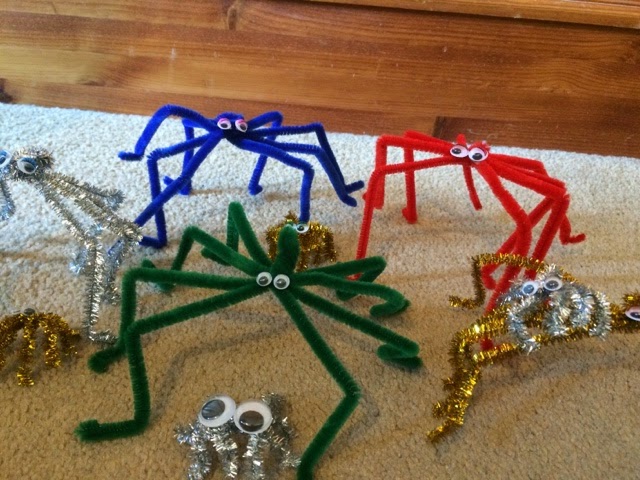
So far we have made pipe cleaner spiders:


We've met a cockchafer larvae, 6 butterfly caterpillars, 5 damselfly larvae, 2 crane flies, a garden spider, a daddy-long-legs spider, countless worms, snails & wood lice and a cross earwig.


We've made leaf fireworks:


We've done conker painting (hence the paint-covered carpet) and I've hole-punched a whole pile of pretty autumn leaves so that we could thread them onto string to make decorations.


We've made spider paper aeroplanes, coloured in some lovely autumn pictures & stuck seeds, leaves & twigs into scrap books with many, many strips of sellotape. 

We've also wiped down the toilet mirrors A LOT after washing our hands and I have shouted "stop playing with Mrs Keeler's electric pencil sharpener" more times than I can count, but boy have we had fun!

But, I just couldn't do it without my girls, who are the best little helpers anyone could ask for, and if it hadn't been for Sharon, the school Family Liaison Officer (who probably regrets ever saying she'd be more than happy to help), I doubt I would have lasted more than a week!

Thursday, 14 August 2014

Lovely Leaf-Cutter Bee

I do love a Leaf-Cutter Bee, but the one I saw the other day was extra special.

Leaf-Cutter Bees are solitary bees who lay their eggs in leaf-lined nests which they build themselves. 

They look for a suitable hole & then focus all their attention on cutting & collecting leaves which they line the hole with, creating a tube-like structure.

An egg is laid inside & the hole is capped with one or two more leaves. They even produce their own special glue-like substance to stick it all together.

Insects are like little machines, designed to work in a specific way. They are programmed to do what they do & they just... well.. do it! However, I believe that my little leaf-cutter bee may have been created with a slight malfunction (or maybe she just needs practice).

Standing in the garden, I heard a buzzing sound, but not like a bee just buzzed past - more like a bee had got stuck somewhere. I turned to look and found this little bee trying in vain to squeeze into one of the many accommodating holes in my insect box with a piece of leaf held between her legs under her body.

Usually a bit of forceful shoving gets a leaf into the right position, but this little lady had obviously been having trouble. All around her were beautifully cut pieces of leaf caught in the cobwebs at the front of the box. This issue was not new to her - she'd been here sometime! 

I watched for a while. She pushed & shoved and eventually got it into the hole, but she wasn't happy. As she flew out she stuck her head in a few other holes, probably to check them out as suitable alternatives. Eventually she buzzed off & when I came back later the hole was half lined as it had been when I had last been there. There were more leaves stuck in the cobwebs though, so she hadn't given up easily, but it was looking unlikely that she'd persevered.

Even though I truly felt sorry for her, I must admit it did keep me amused for a while. She stood out for me as an individual - and that's not common in the bee world. Poor little thing - I hope she found her perfect hole!

Sunday, 20 July 2014

Post-floral whateries?


It was "that" hot day in July when the Purple Vetch seeds "pop" from their seed cases. As I stood trying to get a glimpse of it in action I became aware of two or three ants hanging around at every leaf node along the stems of the plant. What were they doing?

A busy bee on a Vetch flower
Whatever it was, they were all on the same mission and all seemed to have a bit of a thing for a nice green leaf node.

Now, I could narrow the behaviour down to something to do with reproduction, survival/defence or food source, which you can do with pretty much any living thing, apart from humans who seem to be constantly distracted by many meaningful (or not so meaningful) tasks. So I was heading for the food source idea.

I know that ants like to drink sweet stuff - who hasn't found one in a glass of fizz or squash at some point? 

And I also know that plants produce sweet nectar, but surely that's just from the flowers...


Well, it seems not. After a bit of research I found out that it's all to do with "Extra (or "Post") Floral Nectaries" (EFN) - a phenomenon which has barely been researched, especially here in the UK. 

It turns out that some plants produce nectar from their leaf nodes & other areas as well as their flowers, but why? 

Well again, it's either reproduction, survival or food source & from the plants point of view this is all about survival/defence.

A Purple Vetch wants to successfully reproduce & to do this it has to protect it's seeds from danger until it's pods are ready to "pop", at which point it has accomplished it's task. 


Drunk & Disorderly Ants
The plant & the ant have evolved a symbiotic relationship. 

There are many plant pests who would happily munch on a Vetch seed, but much like ants defend aphids in return for a sweet treat, in this case the ant is defending the plant & it's seeds in return for some of the plant's nectar - isn't that incredible! 

So, why don't ants just help themselves to the nectar directly from the flowers? Apparently, they are physically prevented from taking floral nectar by the dense stamens - yet another clever trick!


Tuesday, 15 July 2014

Ants - the aphid's defender!


If you ever find aphids on your plants at home, before squirting them with something toxic, take another look. 

Where there are aphids there are usually Black Garden Ants.

Why? Well, they've learnt that teamwork can benefit them both.

Aphids are a great meal for a hungry Ladybird, but they've found an ingenious way of protecting themselves. They produce a sweet nectar from their bodies which ants just love to drink. 

The ants stroke (or "milk") the aphids which respond by producing blobs of "honeydew" for the ants to drink. In return, when a hungry Ladybird comes a-hunting, the ants see it off!

It's been proven that this sugary substance gives the ants an addictive high - they get "drunk" on it!


More amazing ant facts (not UK species, but definitely worth a mention):

Leafcutter Ants are the foragers & gardeners of the ant world. Leafcutter ants are capable of carrying over 50 times their own body weight. They carry leaves back to their nest and use them to make a fertiliser to grow their own special fungus-food in! They tend this fungus garden which is their only food source.


Fire Ants form living rafts to move the colony away from flooded areas. 
Fire Ants have developed the ability to team together to form a raft to survive the flooding of their habitat. The entire colony links arms and legs and floats above the water's surface - incredibly, even the ants on the bottom layer stay dry! 

Harvester Ants Vs Night Ants 
In the Arizona desert food is scarce & the only things ants can eat are seeds. Harvester Ants collect the seeds during the day, but have to be fast as the desert heats up quickly. 

By nightfall they are back in their nests having filled their underground larders with seeds. 

When they are safely tucked up for the night another species of ants wake up & start to forage - the Night Ants. But, seeds are scarce in the desert & more often than not there are few about by nightfall because the Harvester Ants have collected them all. 

The Night Ants though, have a cunning plan. They spend the night shifting stones & plants to block up the holes of the Harvester Ant's nest - by morning it's clear why - they've trapped the Harvester Ants in the nest! 

It takes the Harvester Ants most of the next day to clear away the rubble, which means they have less time for foraging, which in turn means that by nightfall there are still seeds on the ground for the Night Ants to collect! 

Fantastic!


Monday, 14 July 2014

A mysterious noise!

Wandering around the patio with my camera slung round my neck, waiting in anticipation of what might flit past me I was intrigued to find that it was actually my sense of hearing that was pulled to attention before anything else.

In front of me was a pile of sleepers, some Purple Vetch, a wooden planter and an old hollow tree trunk lent up against it for decorative effect & I was suddenly aware of a scratching sound - or was it popping - or nibbling - I wasn't sure, but it was pretty loud! There was something there, but where? 

It was either coming from the hollow log or the planter so I lifted the hollow log away & the sound came with it! Aha! It was in the log. 

I listened more closely & realised it was a nibbling sound - was it a beetle or shock horror - woodworm?! No there were no woodworm-sized holes. Phew! I looked all around the outside of the bark for tell-tale signs - nothing! I was going crazy - there was this incessant nibbling and nothing to see! What the hell was it?

Then, all of a sudden, a "poof" of sawdust shot out from the inside of the log - and there at the top of the inside of the hollowed out log was a hole no bigger than 1cm across. Something had kicked the sawdust out and was nibbling a tunnel through my log! What could it be? Well I got myself comfortable on a garden chair & positioned myself with the camera resting on the log ready to snap whatever it was as it emerged. 

20 minutes later... still nothing to see, another 10 minutes of nibbling and I could feel the back of my neck burning in the midday sun and the guilty pull of all the housework I should be getting on with inside. 

Then all of a sudden - pop - a furry bottom! A bee was backing out of the hole! I snapped & snapped, but only got this rather unflattering shot - it was so fast! Off it flew, probably to get itself some lunch.

After a bit of research I found out that this was a type of carpenter bee - you can see why.

I checked a couple of times later in the day & the nibbling was still going on. Two days later she was still nibbling! She was one busy little mum-to-be-bee!

Monday, 30 June 2014

A missed opportunity!

This gorgeous specimen of a bug was spotted in amongst my Geraniums a few weeks back. Was it a Firebug? Nope - not the right shape & different markings. After a bit of detective work I found out that it was in fact Corizus Hyoscyami, aka a Cinnamon Bug.

Well, I took a picture (a blurry one I must admit, but at that point my macro filters were winging their way to me via Royal Mail, so I was unable to pick him out in all his glory) & found out that they are pretty rare in the UK, never having been found any further north than Liverpool.

I thought that was it, but whilst idly googling the other day I came across a fact that I was completely unaware of until that point - that the Cinnamon Bug is so called because it SMELLS OF CINNAMON! Aaaargh! Well it was long gone & I'd missed my opportunity to have a good sniff - boo-hoo!!

So, why are bugs so brightly coloured? 

Aren't they picked off more easily by birds if they are so obvious? No - why? Because to a hungry bird that bright colouring means "Don't eat me, I'm poisonous" even if the bug is not! 

Plus, as a female bug looking for a mate, you want to choose the best male to father your offspring & the brightest colours & the most symmetrical markings are a sign of being strong & healthy.

I feel bad I didn't get a good whiff & I don't feel my photo has done this lovely chap justice, but hey it's another species added to the list & a rather special one at that. 

5 little speckled frogs

I can't believe I forgot the frogs in my last post!

I'm not sure how many visit us, but I've seen at least 5 together & on a hot sunny day they like to sit on the rocks under the waterfall (which incidentally I don't put on for fear of filtering out a large part of my little eco system) where there is a dark cool pool of water for them to have a dip in as and when they feel like it. 


And this year I was ridiculously excited when I found our first ever batch of frogspawn! Unfortunately, so were the newts I think, because I saw few tadpoles this spring and zero froglets & a tadpole is a protein packed snack for a hungry newt.


Apparently frogs can't see you unless you are moving, but I think my frogs know when I'm there. Peering into the gap between the waterfall and the rocks is a daily event for me & they always seem to be staring straight at me when I eventually spot them in the gloom.


Sunday, 29 June 2014

A pocket of perfection

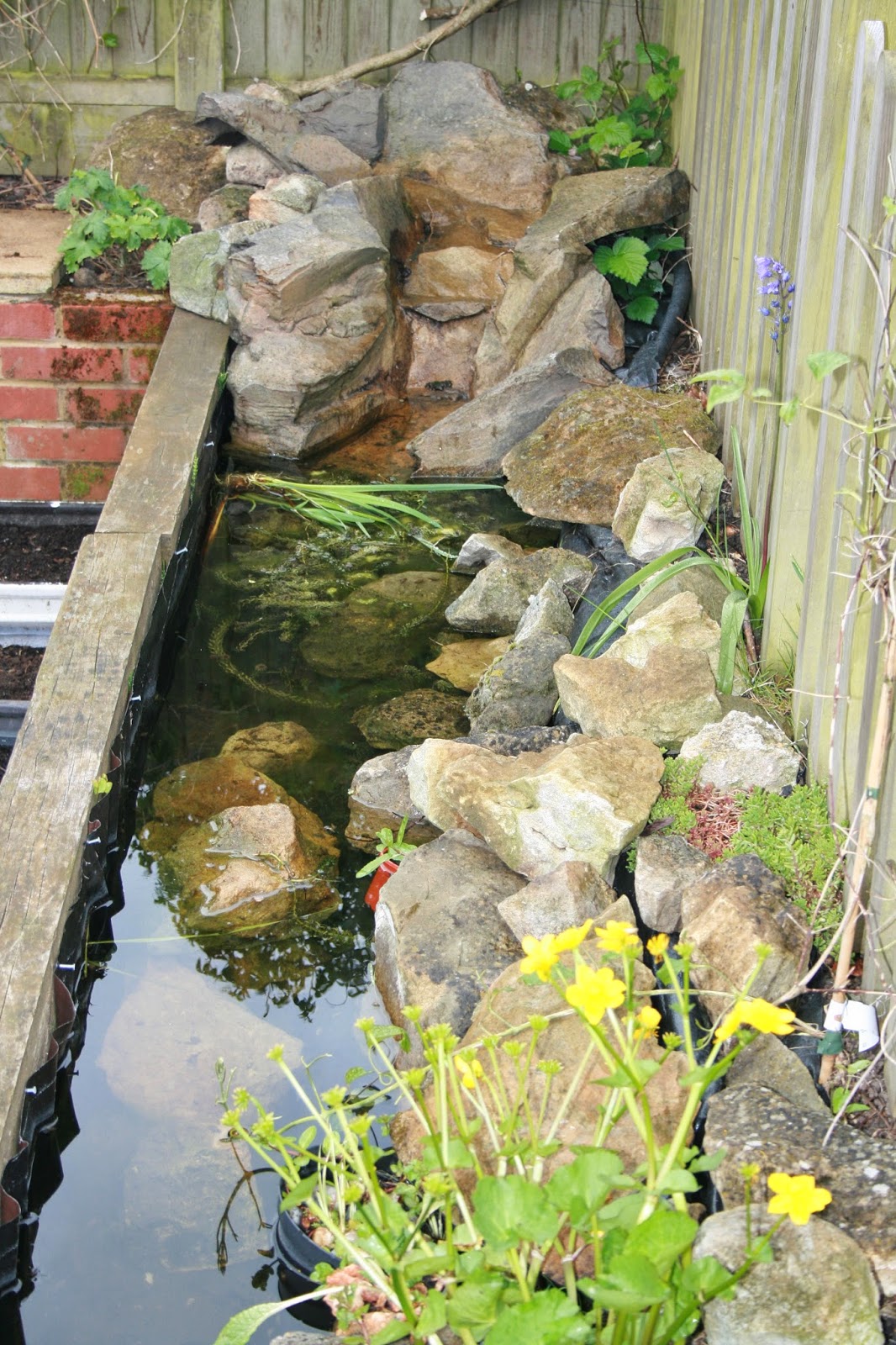
Our little rill - the very first day...
Our little rill - a year on...

...but just look at it now!
Blooming with colour, not just from the flowers on the fence & the submerged plants within the water, but from the beautiful damselflies who choose it as a prime spot to meet their mates, lay their eggs & live out their nymph stage within the water. 

On a sunny day we are honoured to be visited by up to 13 individuals at any one time! The Large Reds & Common Blues take centre stage & it is fascinating to watch them dart about & to watch the female being clasped by her mate & laying her eggs in the pond weed.


Not to mention our Hoverfly, who seems to think it is ALL his territory!


And the beautiful bees - one day I'll work out which species they all are.


And when you start to explore the water you find a little self sustained eco-system (or maybe even a few) - we have seen so many species from pond snails to dragonfly nymphs, damselfly nymphs to newts, newtlets to freshwater shrimps, bloodworms to Pond Skaters. 

And the most amazing thing of all is, they chose OUR little rill to live in, reproduce & die. They've chosen to spend all their precious days in our little rill. I feel very honoured. 


Thursday, 30 May 2013

Beautiful Bee-Fly!

I had a call from my sister Tracey, who, knowing my obsession with insects, thought I might be able to enlighten her and identify a flying insect she'd seen in her garden. It hovered like a little Hummingbird and I guessed that it could be a Hummingbird Hawkmoth. I've never seen one, so was suitably jealous when she told me about it!

However, she sent me a photo and as I opened the text message I was delighted to see this little chap - a Bee-Fly, and what a beautiful photo!

They look just like bees with their furry little bodies, but a closer look reveals yellowy-brown hair on the body, long spindly legs and a rather menacing (but completely harmless) long, straight proboscis. 

How I'd love to have seen one in the flesh - well, as it happens, I didn't have to wait too long.

A week or so later I was with the family at Mum and Dad's house for a lazy afternoon eating gorgeous home-cooked food and catching up with everyone, when Bethany came running in from the garden to tell me that she'd seen one hovering by the flowers! I couldn't believe my luck & was thrilled to be able to watch a beautiful Bee-Fly hovering around the Grape Hyacinths along the garden wall.

It chose a flower, hovered ever more closely and inserted it's proboscis in the flower opening, hovering just like a tiny furry Hummingbird, oblivious to my presence.

Needless to say Bethany got extra ice-cream and cuddles after dinner! What a thrill!  

Sunday, 15 July 2012

Blue-Tailed Damselfly Action


My finger has just been privileged to have been chosen to be a Blue-Tailed Damselfly's perch for over half an hour! Bethany found it on the floor. It's been a pretty dull day with a few bouts of sunshine - one of which was convincing enough for the Damselfly to believe it was going to be ideal flying time. I guess it must have been cold and needed to increase it's body heat before taking to the air again, because it was walking along the floor looking very sorry for itself. I held out my finger in front of it and it climbed on board and there it stayed. Fortunately for me the skies stayed pretty miserable and grey so it just sat and waited, with it's front feet clasped round the end of my fingernail.


Straight on it looked as though it was staring me out! It was truly stunning. A beautiful specimen, with a shimmery bronze and black abdomen ending in a bright blue patch at the end. The stripes along the thorax were a gorgeous bright green and it's perfection just blew me away.

Thursday, 16 February 2012

In need of another Bug-Fix

The other day, as my children ate their breakfast at the dining room table and I stood at the window looking out onto a snow covered garden, I said out loud "oh I can't wait for Spring - I'm missing the bugs".


I spoke too soon... that morning as I combed through Holly's hair I found... a nit egg... and then we had a tummy bug. That was really not what I meant.

However, since then I have seen - a caterpillar and a Lacewing - that's more like it! I reckon the caterpillar came into the house courtesy of my gardener husband's work clothes. I first noticed it at around 9:30am, crawling across the ceiling from the corner of the room. I wasn't sure what to do. I couldn't put it outside - that was just a death sentence in the middle of winter, so I let it crawl aimlessly and it caught my eye every time I walked under it.

At around 5pm we sat down to eat dinner and I looked up and saw that it was heading straight for the smoke alarm. By the time we'd finished eating, it had disappeared, presumably into the smoke alarm! Not sure if that's a good thing or not...


Lacewings are beautiful creatures, like little fairies - their wings are so delicate, just like lace or net. The females have a very nifty way of protecting their eggs from being predated by crawling insects, such as ants. An egg laid directly on a leaf is asking for trouble, so a female lacewing produces a drop of silk which then hardens as it is stretched to make a long thin stalk. Then an individual egg is laid on the end, suspended in mid air, safely away from predators! Genius.

Roll on Summer!

Tuesday, 24 January 2012

Winter Bug Sports!

I was getting withdrawal symptoms - there are few bugs about in the depths of winter, but my daughters found a Snail Racing printout whilst we were having a January clear out, so we made it and had our very own Snail Race!

I really didn't think they'd manage to find any snails, but they came back into the house with no less than 32 little "snailets" (my children are well trained in bug hunting)!

Spikey (Orange), Sticky (purple) and Smelly (green) raced to the finish... and the winner was... Smelly!!!

You'll be pleased to hear that no snails were harmed during the making of this race and we released them all back into the wild, exactly where we found them!

Happy Days!

Friday, 2 September 2011

Lovely (?) Lily Beetles

The Lily Beetle is a bit of a love-hate-love critter for me. Beautiful and fascinating it's hard to dislike them until you try to grow your own Lilies...

This one here, along with all her posse has managed to all but destroy my beautiful white lily plant. Three years after receiving it as a gift from hubby for our Wedding Anniversary, it's a shadow of it's former self.


However, as insects go, they are pretty cool. Firstly, that scarlet red colour is very exotic and I love the way they drop from the leaves onto their backs the moment you touch them, skillfully disguising their bright colour and pretending to be dead. Apparently they squeak too, if you try to handle them, but I have surprised myself by not attempting to try it yet.

Their larvae are brilliant in that they disguise themselves as dollops of bird mess by covering themselves in their own poo!! Utterly gross, but wow, it'd put anything off!

I may have to try that squeaking thing... gently of course.

Sunday, 28 August 2011

Autumn already?


I'm getting the idea that the wildliife around these parts have decided it's Autumn. It's only August!

Mainly it's the spiders. I've found two or three male house spiders in the last few days, all in the bathroom. Actually maybe it's the same one... I do chuck them out, but they try to get back in.

You can tell they are (or "it is") male because of the enlarged palps, the mouthparts.

Autumn is the House Spider's mating season and the males start moving out from their hiding places in search of females.

I would love to shrink to spider size and watch the hunts and scavenging that goes on in my house of a night! We have countless wolf spiders in our garden, around our patio. They like to sun themselves. A couple have found their way into the house and made little silk funnels in dark corners.

We had one that lived just outside the shoe cupboard and one that lived under the tumble dryer. I would see them quite regularly waiting for their dinner to step onto their territory.

Late at night I've seen Silverfish racing across the floors and found a Daddy Long Legs Spider carrying a dead one up a wall the other week! It made me think of a scavenging hyena. After all, Daddy Long Leg Spiders are scavengers too.

Can you imagine what it must be like at night, like a Kenyan desert plain, an epic of life and death! I'd love to see it.


Sunday, 7 August 2011

Snail Sexy Time


Apologies for the use of the following irritating phrase, but there is no choice;


Oh.   My.   God.


I have just seen a snail's sex organs...


I should set the scene before I launch into a fascinating description.


Sultry August Sunday afternoon, cousin's beautiful Victorian cottage garden, impending summer BBQ, the girls are arguing over a snail...

And so it begins. To appease my rowing children and save a poor lowly snail from becoming an innocent bystander mutilated during a riot, I started to hunt for more snails and spotted two in an old pot behind the shed. They were stuck together and I presumed sheltering in a cool spot away from the heat of the sun... but I was wrong.

I pulled them apart and at first I thought they had parasites growing on them, before I twigged that actually I had just interrupted a passionate mollusc moment.

It was utterly fascinating. Each one had a white growth protruding from the side of its head (some sort of lady bits) and what looked to me to be a piece of fishing wire next to it (a snail penis!). It was one of those scenes that you can't help but keep looking at even though it makes you feel a bit queasy.

They had realised their sexual liaison was over, so I quickly called the girls over and we watched them sucking their own sex organs back inside their bodies and turn once again into a couple of innocent snails.

What can I say? It was a brilliant afternoon. The BBQ wasn't too bad either.

Sunday, 22 May 2011

Talking of Bloody-Nosed Beetles...

I mentioned that one of my many favourite insects is the Bloody Nosed beetle. I've only ever seen one, but I was mesmerized by it.

It walked cumbersomely along my window sill and straight into a spider's web. Luckily there was no spider in it, but it slowly squirmed and tried to pull itself free, but I had to help it in the end. Such a delicate operation. I was terrified of damaging it, but it escaped scot free with a bit of cobweb trailing from one of its back legs. You could see it was well aware of the extra weight and it tried in vain to kick it off!

Every time my shadow passed across it and it could sense my close presence, it ducked its little head back! It moved so slowly that I was able to go and get my insect identification book and we (me and the girls) worked out that we had found a Bloody Nosed Beetle, which, according to my book, is flightless and (cue oohs and noises of great interest) "gets its name for its habit of releasing a drop of blood from its mouth when disturbed".

Well... I had to give it a little go... I gently knocked it and wobbled it about, but it just kept walking as if it was totally unaware (or maybe, bless it, that was lightening speed for a terrified Bloody-Nosed Beetle), but nothing happened and I gave up because I felt rather guilty for trying to upset it. I moved it over to a grassy area where it could hide away from birds and cats and we watched it clamber slowly away..

I researched it further that evening and found out that they only release the blood when they are very stressed... ooh dear. Oh well, at least I hadn't upset it too much. You never can tell with a beetle.

However, the next day it was back where I'd first found it, about 6 metres away from where I'd "thoughtfully" placed it out of harms way the day before. The poor thing had probably spent the whole night getting back there. It must have been heading for somewhere in particular! This time, my 4 yr old had found it first and as I went to pick it up... a drop of blood... oh the guilt. I left it alone and it crawled under the door and hid safely away.

Now that's one cool beetle!